No products in the cart.



Springless Trampoline vs Spring Trampoline: Which Is Safer for Kids?
Springless trampoline vs spring trampoline is the first comparison most parents make, and safety is the reason. The two designs are built differently, jump differently and cost differently. Rainbow Direct sells springless models only, so we will be clear about where that gives us a point of view.
This guide covers how each design is built, what the safety differences really are and what supervision still has to cover. The springless trampoline vs spring trampoline choice changes the hazards built into the product, but it does not change the rules of the house. A hidden frame or a net helps, and no design replaces an adult watching.
How springless and spring trampolines are built
A spring trampoline connects the jumping mat to a metal frame with coiled springs. A springless trampoline replaces those springs with flexible rods that sit under the mat.
Every trampoline Rainbow Direct sells is springless. If you want the full picture of the premium line, start with our Springfree trampoline NJ guide.
What our springless models use
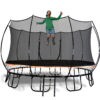
Free Jump trampolines use aviation-grade aluminum rods. Springfree trampolines use flexible composite rods. Both lines have a hidden frame and a zippered net enclosure.
You can see every model on the trampolines page.
Where the frame sits
On a Springfree, the frame sits beneath the jumping surface instead of ringing the edge. Rainbow Direct describes the result as a trampoline without springs or hard edges.
Springless trampoline vs spring trampoline: the safety differences
The springless trampoline vs spring trampoline debate usually comes down to two worries. Those are pinch points and hard edges.
Pinch points and hard edges
Springfree trampolines have no coiled springs and no hard frame edge around the jumping surface. That design removes the pinch points and hard edges that families worry about with older spring models.
Removing a hazard is not the same as removing all risk. Kids can still fall or collide with each other.
The net and the gap around the mat
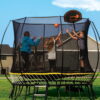
The Springfree net is zippered and flexible, and the curved enclosure rods move with your child, according to Rainbow Direct. There are no gaps between the mat and the net where small hands and feet can get caught.
What the design does not change
The U.S. Consumer Product Safety Commission advises one jumper at a time and adult supervision. It also says children younger than 6 should not use a full-size trampoline, and it advises an enclosure to help prevent falls.
Those rules apply to every trampoline, springless or not.
How the jump, the size and the price compare
Rainbow Direct’s trampolines page promises superior bounce along with the safety design. Bounce is subjective, so jump on one if you can.
The Springfree 11′ x 11′ trampoline has 113 square feet of jumping area. Its product page says that matches the jumping area of a 13-foot spring-based model.
| Springless line | Rods | Sizes | Installed price |
|---|---|---|---|
| Free Jump | Aviation-grade aluminum | 10′ round, 11′ x 11′ square, 14′ x 14′ square | $1,499 to $1,999 |
| Springfree | Flexible composite | 8′ x 13′ oval, 11′ x 11′ square, 13′ x 13′ square | $1,799 to $2,499 |
Installed prices as listed on rainbowdirect.com in October 2026. Prices can change, so confirm with the showroom before you order.
In any springless trampoline vs spring trampoline price comparison, ask whether assembly is in the quote. We do not sell spring models, so we cannot price one for you. Our guide to how much a trampoline costs explains what drives the total.
Free Jump or Springfree
Free Jump is the lower-priced line, and its 10′ round at $1,499 is the lowest listed price on the site. Springfree costs more at the same footprint, since the 11′ x 11′ lists at $1,999 against $1,799 for the Free Jump 11′ x 11′.
Browse the Free Jump trampoline collection and the Springfree trampolines collection side by side. Both lines are installed by the same team, so you can compare them in one visit.
Rainbow Direct · New Jersey
Want to jump on both springless lines before you decide? Visit our Parsippany showroom and get an installed price for your yard.
Request a free estimateChoosing a springless trampoline vs spring trampoline for your family
The springless trampoline vs spring trampoline decision should start with your children’s ages. The CPSC guidance on children younger than 6 matters more than any feature on a spec sheet.
Then measure your yard.
The Free Jump 10′ round needs 15′ x 15′ of clear space, and the Free Jump 11′ x 11′ needs 19′ x 19′. The Springfree 11′ x 11′ needs 21′ x 21′, and the Springfree 8′ x 13′ needs 18′ x 23′. Springfree total height is 9 feet, so look up as well as across.
Weather, warranty and upkeep
Rainbow Direct says its frames are rust resistant and its nets are UV protected, so a trampoline can stay outside through the seasons. The same page advertises a 10 year warranty, so ask the showroom for the written terms.
Wind is a different matter. The CPSC says not to jump in high wind because a trampoline can shift, move or blow away.
Installation and delivery
White glove professional installation is included in all of Rainbow Direct’s residential trampoline pricing. Our team delivers and installs across the tri-state area, and a delivery fee may apply outside the service zone.
Learn more about our professional delivery and installation service before you book.
Ladders and accessories
For families with young children, Rainbow Direct recommends adding a ladder to a Springfree. The trampoline accessories collection lists the FlexrStep at $99.
If you are building a short list for your child’s age group, our guide to the best trampoline for kids walks through size, shape and safety features.
Safety habits that apply to every trampoline
A safer design lowers the odds of a problem. Habits do the rest.
Before each jump session
The CPSC advises checking the trampoline regularly for missing parts and for rips or tears in the pad. A quick walk around the trampoline takes a minute and catches most problems early.
Who jumps and who watches
Allow one jumper at a time, and keep an adult watching the whole time. A spot you can see from the kitchen window makes that easier than a far corner of the yard.
Where it lives in the yard
Place the trampoline away from structures, trees and other play areas. If your yard already has a Rainbow swing set, give each piece of equipment its own space instead of squeezing them together.
Frequently asked questions
Is a springless trampoline safer than a spring trampoline?
A springless design removes coiled springs and the hard frame edge, which are the pinch points and hard edges families worry about with older spring models. It does not remove the need for supervision. The CPSC advises one jumper at a time and an adult watching.
Are springless trampolines worth the extra cost?
Rainbow Direct lists its springless trampolines from $1,499 to $2,499 installed, and professional installation is included. You are paying for the springless design, the hidden frame, the net and the setup. Whether that is worth it depends on your kids’ ages and how long you plan to keep it.
Do springless trampolines bounce as well as spring trampolines?
Rainbow Direct’s trampolines page promises superior bounce on its springless models. The Springfree 11′ x 11′ product page says its jumping area matches a 13-foot spring-based model. Bounce is personal, so try one in a showroom if you can.
What age can kids use a springless trampoline?
The CPSC says children younger than 6 should not use a full-size trampoline. Springfree models list a limit of 220 lbs per jumper, and only one person should jump at a time. Match the purchase to your kids’ ages today and in two or three years.
Ready to compare both springless lines in person? Get your free estimate from our Flemington showroom team, which serves families across Hunterdon County. Installation is included in every listed price, and the current specials page shows any active offers.